Professor Giovanni Bisignani presents TrAIcorder on Testa o Croce
In the 8 August 2026 episode of Testa o Croce, Professor Giovanni Bisignani discussed TrAIcorder, from the initial expression of interest at Exposanità Bologna to its potential for prevention and screening in Calabria.
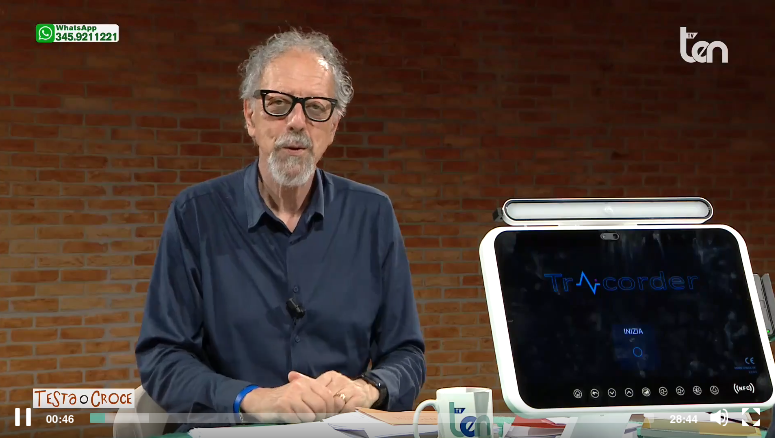
Testa o Croce · 8 August 2026
On the television programme Testa o Croce, cardiologist Professor Giovanni Bisignani presented TrAIcorder and his vision of prevention that is faster, more accessible and closer to local communities.
The interview, broadcast on 8 August 2026, was an opportunity to tell the story of a meeting that began at Exposanità in Bologna. This is where Professor Bisignani first discovered TrAIcorder and decided to explore how it works and how it could support prevention pathways.
Interview with Professor Giovanni Bisignani on the Testa o Croce programme. · Watch the video
From Bologna to first-hand assessment in Calabria
After meeting the team at Exposanità, Professor Bisignani took a number of devices to Calabria to assess them directly in his professional setting. The experience generated strong interest and opened a practical discussion on how non-invasive technology can make initial checks and local screening initiatives easier to access.
The Calabria Region has shown great interest in TrAIcorder and in the opportunities that non-invasive technology can offer for prevention and screening across the territory. This is an important signal for continuing to build, together with professionals and local organisations, health pathways that are increasingly close to people.
A new opportunity for the local area
Calabria can become a meaningful setting in which to explore more widespread prevention: an approach where technology, professionals and local organisation work together to bring health checks closer to people.
Changing the screening paradigm
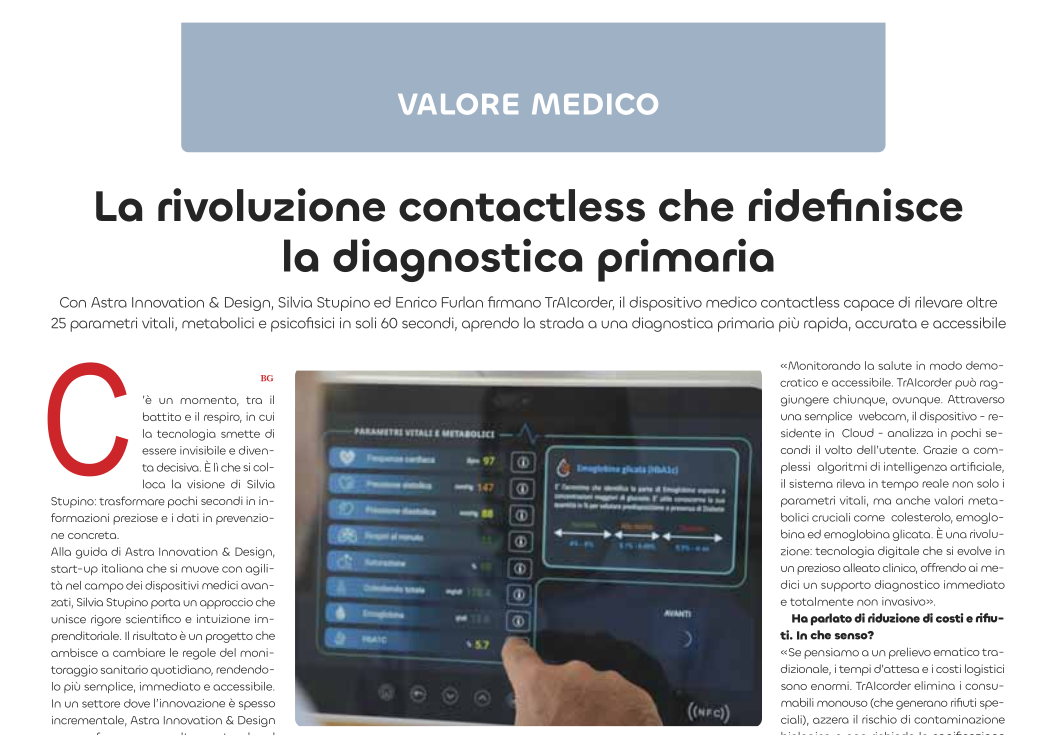
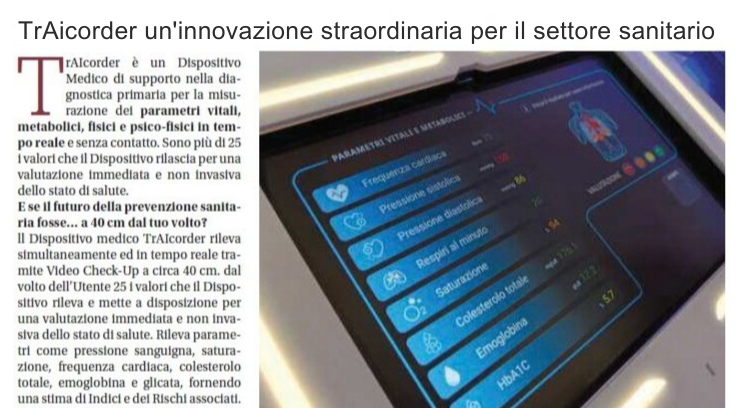
One of the central themes of the interview was the shift in approach that TrAIcorder proposes for prevention and large-scale screening. Through a simple video acquisition, the technology provides rapid, contactless analysis: an experience designed to reduce practical barriers, encourage participation and bring an initial check closer to people's daily lives.
Its non-invasive mode also offers an organisational and environmental advantage: no consumables are required to perform the acquisition. This can streamline screening initiatives and help avoid waste of disposable materials, particularly in high-throughput settings.
Fast
a response processed in a short time, helping make the first stage of screening smoother.
Contactless
no physical contact and no consumables required for the video acquisition.
Local
technology designed to be integrated into settings close to people.
Comparison with clinical examinations
During the programme, the journalist shared observations after the Video Check-Up, noting that the data presented by TrAIcorder corresponded with clinical examinations already carried out. This made the potential of a quick and accessible reading of parameters in support of prevention immediately understandable to viewers.
TrAIcorder does not replace a physician's assessment or any necessary diagnostic investigations. Its value lies in offering a rapid first level of analysis that can be integrated responsibly into screening, monitoring and health guidance pathways.
Innovation developed by Ad Astra
The interview also discussed Ad Astra Innovation & Design, the company that developed TrAIcorder. The solution combines remote photoplethysmography, signal analysis and artificial intelligence: technologies serving a simple user experience and fast processing for prevention settings.
The speed of the response and analysis is central to this vision. Reducing time does not mean simplifying clinical complexity; it means making an initial data point available sooner, so that the healthcare professional can use it in the most appropriate pathway for each person.
Professor Bisignani's experience confirms the interest in tools that combine innovation, sustainability and proximity. For TrAIcorder, the discussion opened in Calabria is an opportunity to be built with rigour and collaboration.